
28 Years of Exploration Cruises: From Scientific Expeditions to Grand Cruises—The Origins of a Project.
Polar expedition cruises originated in France as the brainchild of Christian Kempf, who wanted to combine exploration of the Far North with environmental conservation by turning tourists into the best ambassadors for the protection of this unspoiled natural environment.
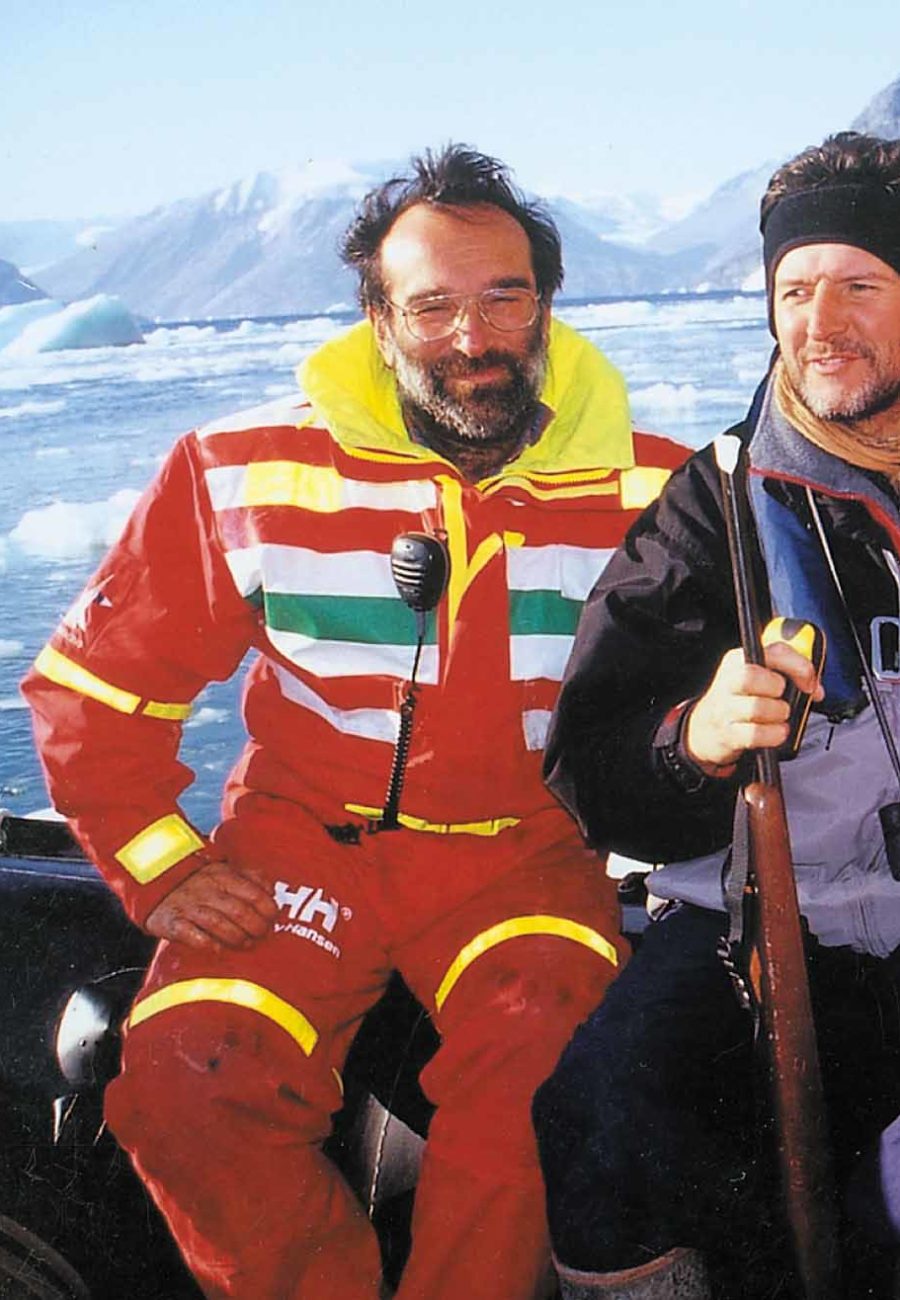
Between 1973 and 1989, he had led 15 expeditions to Spitsbergen, Greenland, and Canada with his friends—naturalists and scientists.
Starting in 1985, Paquet Cruises invited him to give lectures during luxury cruises to Spitsbergen aboard the Mermoz; later, many other companies operating large cruise ships would enlist his services. This is how he discovered the world of cruising and the atmosphere on a ship’s bridge. At the same time, in 1985, he launched polar expeditions (using Zodiacs and camping in tents) through Voyages Nature.
Finally, in 1987, with the help of Paul Emile Victor, he organized the first French-language cruise to Antarctica aboard the Argentine polar ship Bahia Paraiso.
Christian Kempf thus gained the essential experience needed to launch, in 1990, the first Arctic expedition cruise aboard a French icebreaker, the Cariboo. Departing from Iceland, this voyage—entirely chartered by Christian Kempf—would head to the east coast of Greenland, toward Scoresby Sund and Emperor Franz Joseph Fjord, crossing 250 km of pack ice over 3 days and 2 nights, before reaching Spitsbergen and circumnavigating the island! And some people who still participate in our expedition cruises share their experiences…
“Every day was a dream…”
⏤ Bernard Soumier, Dijon“It was a huge deal back then—an adventure in the ice.”
⏤ Elisa Chevojon, Vernon
In 1989, Christian Kempf organized the technical aspects of the Illiria cruise and Nicolas Hulot’s team’s expedition to Antarctica, before launching two expeditions of his own aboard the chartered Boris Petrov to Antarctica in 1992, with the Antenne 2 team and Allain Bougrain Dubourg on board.

Russian Ships
Meanwhile, as the Soviet Union opened up, he was the first person in the world to seize the extraordinary opportunity presented by the Russian scientific fleet; for more than 20 years, this fleet would provide the vessels for nearly all polar expedition cruises.
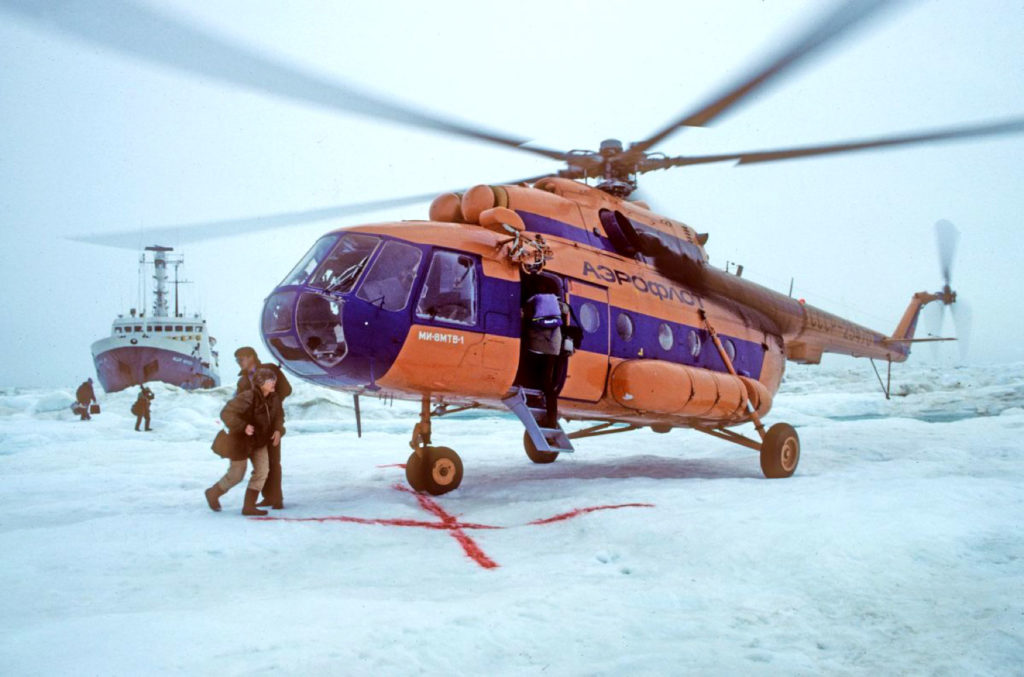
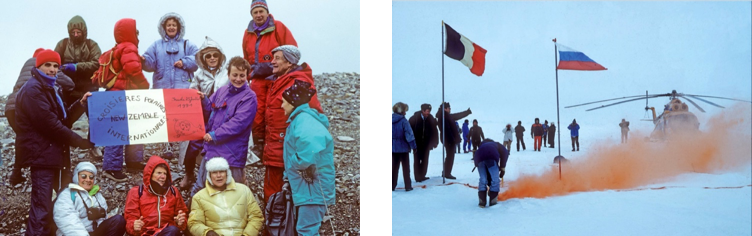
In 1992, Christian Kempf met V. Baranov in a sauna on the outskirts of Saint Petersburg, and amid onions and salted herring, plans were hatched for the first tourist trip to the North Pole, using three helicopters. On April 12, the goal was achieved, and upon their return, the farewell “toast” was held in a room carved out of an iceberg! That same year, he organized the first international symposium on tourism in the polar regions in France: the momentum had been set, and the path laid out.
Starting that year, travel agencies rushed into this niche, eager to capitalize on this windfall and the path paved by Christian Kempf. In the U.S., Canada, the Netherlands, and France as well, tour operators launched these polar trips—with varying degrees of success—while the pioneer continued his training by traveling the world as a lecturer or expedition leader in Antarctica aboard large cruise ships. He accompanied a few cruises, but it was in 1998 that he launched his own ventures with the founding of Grands Espaces, which would become the first organization to charter entirely French-speaking ships, with a team of polar guides that would be the key to its success.
Grands Espaces: Constant Evolution
Starting in 1999, there were two French-language trips and charters to Greenland, followed by three to Spitsbergen, and then, every summer, three to five charters that took us to both Spitsbergen and the fabulous landscapes of eastern Greenland. Our ships at that time were former Russian research vessels carrying 50 passengers, with basic amenities (bunk beds, restrooms often outside the cabins), but the real appeal lies outdoors, where these ships can weave through the ice, our team gets up close to the bears, and our passengers are the first to set foot on the ice floes…
Thanks to the ships’ equipment and, above all, the experience of the Russian captains, each voyage is an opportunity to explore a new fjord and discover new horizons. And every year, the number of passengers grows, thanks to what could be described as Grands Espaces’ “DNA”: a French-speaking environment, expert university-trained guides, small-capacity ships, and good comfort—even if “luxury” is absent—and our ethos: the protection of nature… saving lives at sea. The old Russian ships with a capacity of 50 passengers are being reassigned to other tasks, and the polar fleet is shifting to ships carrying 100–120 passengers, with vessels sourced from the luxury cruise market or refurbished. We will therefore choose the Ocean Nova—with its capacity of just 75 passengers—as our flagship, along with the Ortélius (116 passengers, which we are reducing to 100), as it is the only tourist ship capable of breaking through ice. We will also use other polar ships operating in different regions, as polar tourism continues to grow: the “Ioffe” for the Northwest Passage and Thule, the “Professor Khromov” in the Russian Far East, and other vessels in Antarctica.
Our polar travelers want to reconnect with a crew and its unique atmosphere, which is why our destinations are also diversifying, with a few key focuses centered on our discovery cruises in Antarctica, Southern Africa (safari cruises), the Amazon—where Grands Espaces has acquired a stake in Amazon Dream—and the Galápagos; in addition, certain tours are particularly popular, such as the Kamchatka flyovers, our tours in Namibia, and our Russian New Year’s Eve celebrations… Very soon, Grands Espaces will become the leading organizer of expedition cruises.
For us, the most beautiful evening melody will always be the silence of the polar regions; our luxury lies in the experience and expertise of our team; our “entertainers” are the bears and penguins; and the evening’s highlight is a Zodiac excursion among the icebergs bathed in the light of the setting sun…
To establish this unique identity, Grands Espaces launched the Polaris 1 in 2012 in Spitsbergen and Norway, in partnership with two other associates—a vessel carrying just 12 passengers— the Polaris 1: a success that would lead to other yachts, including the Grand Large, launched in 2017, and an ongoing search for vessels that combine exploration and comfort.
Grands Espaces has always been a pioneer, and in 2015 we launched helicopter tours in eastern Greenland to introduce passengers to the ice cap in collaboration with Greenlandair and the St. Gervais-Mont-Blanc High Mountain Guides Association. That same year, we established a training center for polar tour guides…
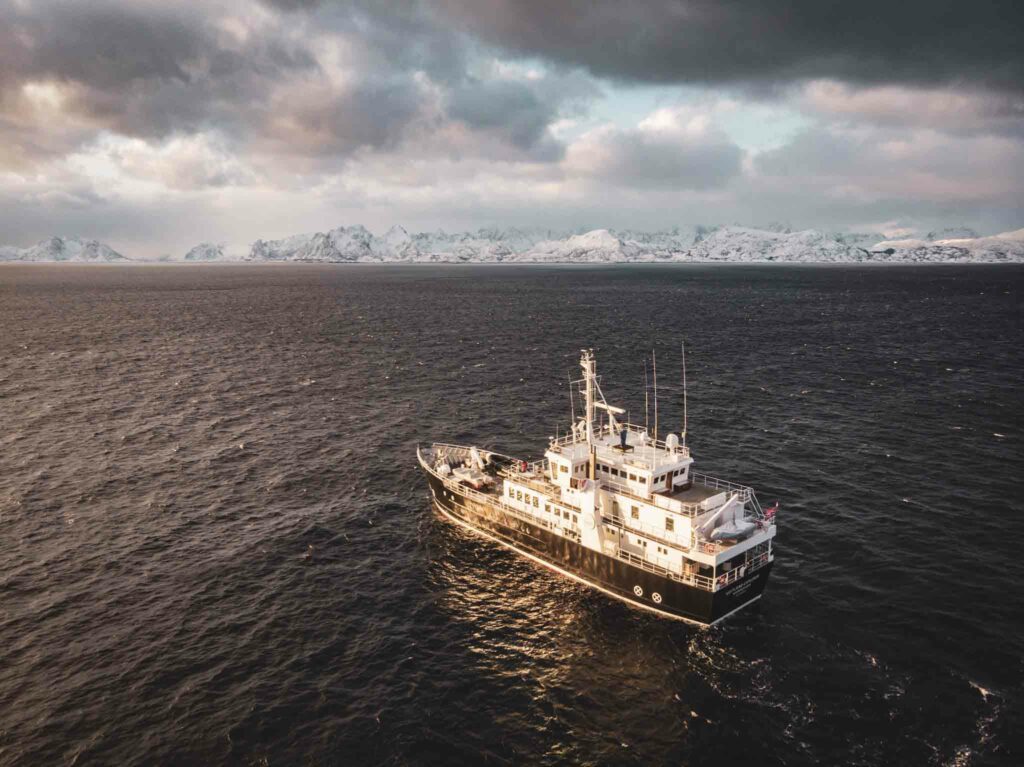
In 2020, Christian Kempf combined his polar expertise with that of naval architect Marco Coppola, who specializes in exploration yachts, to refurbish the Explorer, a vessel now equipped for the open seas and ice. The Explorer, the latest addition to the Grands Espaces fleet, is thus an exceptional polar yacht that combines comfort, refinement, and efficiency.
Toward a Greener Future
- Vessel Refurbishment
One of the cornerstones of our environmental commitment is the renovation and refurbishment of our vessels. Just as with real estate renovation, we believe that modernizing older vessels is a sustainable and responsible approach that is fully aligned with our vision of a more environmentally friendly future.
In the coming years, we plan to integrate technological innovations into ships already in service, such as the Explorer and the Nanook, our polar yachts designed to accommodate 12 passengers. These improvements will aim not only to extend the lifespan of these vessels but also to reduce their environmental impact.
The Explorer, for example, will be equipped with innovative smokestacks that act as “carbon traps.” This system will capture a significant portion of the CO₂ generated during voyages, thereby reducing polluting emissions. By 2027, the port of Longyearbyen will be equipped with specialized infrastructure to process and recover this captured carbon, contributing to a virtuous cycle of emissions management.
This strategic decision to refurbish offers numerous environmental benefits. It limits the consumption of new resources required to build new ships, while reducing the waste generated by scrapping old vessels. Through these initiatives, we reaffirm our commitment to combining polar exploration with environmental conservation, aligning our activities with the unique ecosystems we are dedicated to protecting.
2. The Partnership with Captain Arctic
We firmly believe that the future of tourism lies in the respectful and sustainable exploration of our planet’s wonders. Since our inception, we have always prioritized small-group voyages aboard small ships (12 to 70 passengers) to minimize our impact on the fragile ecosystems we explore, particularly in the heart of the polar regions.
By incorporating more sustainable practices and choosing equipment that preserves the environment, we reaffirm our commitment to evolving with the times. Our approach is guided by a desire to create authentic experiences that reveal the beauty of the polar regions while raising our passengers’ awareness of the need to protect them.
It is in this spirit that our partnership with CAPTAIN ARCTIC was born: the new polar vessel that is reinventing expedition cruising by combining comfort with technological innovations to significantly reduce its environmental impact.
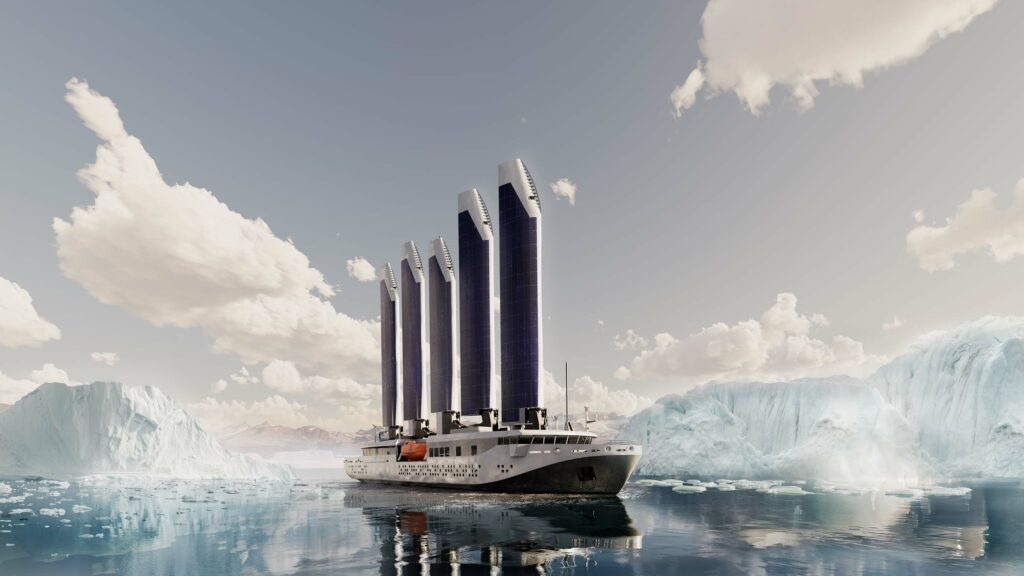
This collaboration between Sophie Galvagnon, a Franco-Swedish sailor and designer of the Captain Arctic, and Christian Kempf, founder of Grands Espaces and renowned explorer, is based on shared values: a deep passion for polar exploration, an unwavering commitment to the field, adventure, and wildlife, and above all, a steadfast commitment to a sustainable future. Together, they are reinventing the art of travel by combining technological innovation with respect for ecosystems.
Equipped with innovative rigid sails, covered with more than 1,800 m² of photovoltaic panels specially designed to withstand polar cold and now patented, the CAPTAIN ARCTIC sailboat embodies an ecological revolution. Thanks to this combination of wind and solar power, it will sail with zero carbon emissions more than 90% of the time, thereby redefining the standards of sustainable sailing.
3. Our New Ships
Starting in 2028, the largest vessel in the Grands Espaces fleet will offer 36 berths, reflecting our commitment to prioritizing exclusive and environmentally friendly voyages. Grands Espaces is currently working on the construction of two new vessels: a 12-passenger yacht and a 36-passenger yacht, both scheduled for delivery by that same deadline.
These new vessels will incorporate major technological innovations, designed in collaboration with our architects and engineers, to reduce their environmental impact while maintaining optimal comfort for our passengers. The 12-passenger vessel, for example, will feature a “bubble mattress” system along the hull, beneath the keel. This technology reduces hydrodynamic drag, thereby lowering fuel consumption by 5 to 8 percent and, consequently, greenhouse gas emissions.
As for the 36-passenger vessel, it will incorporate innovations such as solar-powered windows, capable of capturing the sun’s energy to help power the ship. These technologies, still under development, embody our commitment to evolving the fleet toward ever-more sustainable standards. By committing to these projects, Grands Espaces continues to combine exploration and innovation, while reaffirming its pioneering role in designing polar voyages that respect the fragile ecosystems it traverses.
Grands Espaces is a member of


Tour Operator License in France IM02117002 and in Switzerland CH-626.4.004.351-6 © GRANDS ESPACES SARL